Located along a busy commercial corridor lined with mature rain trees, the project responds to the visual intensity and constant movement of the contemporary city. In a streetscape where buildings, signage, traffic, and urban activity compete for attention, architecture is often experienced in passing—a fleeting impression caught between moments. The project embraces this condition, seeking to create a building that is immediately recognizable from the street while offering a deeper and more layered experience to those who inhabit it.
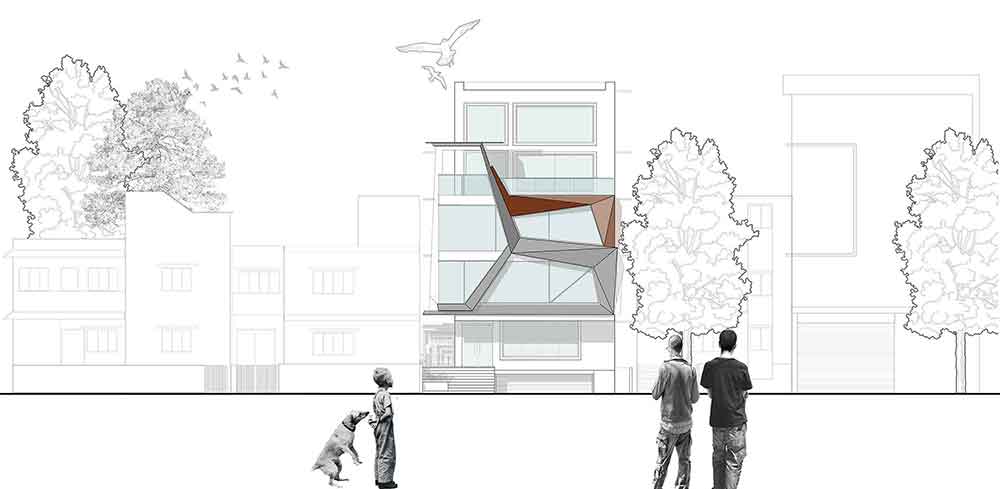
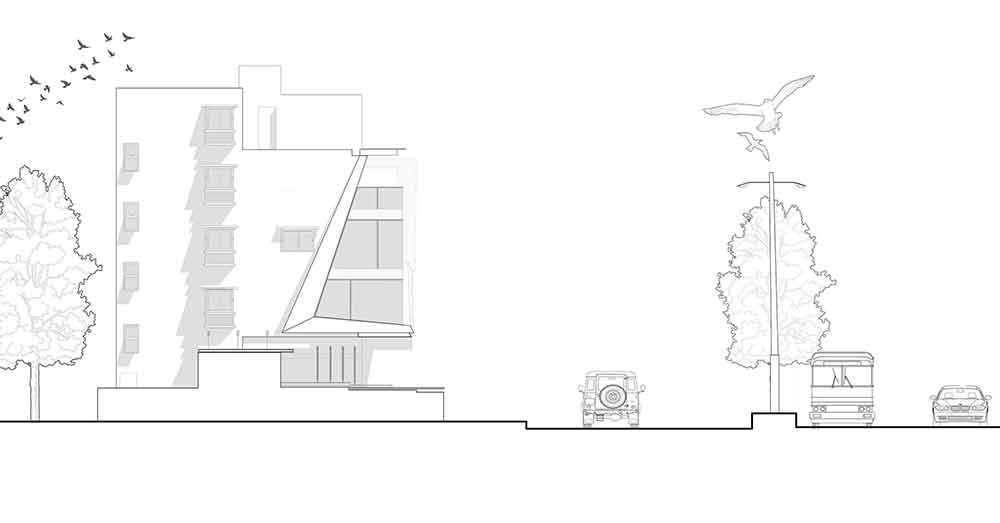
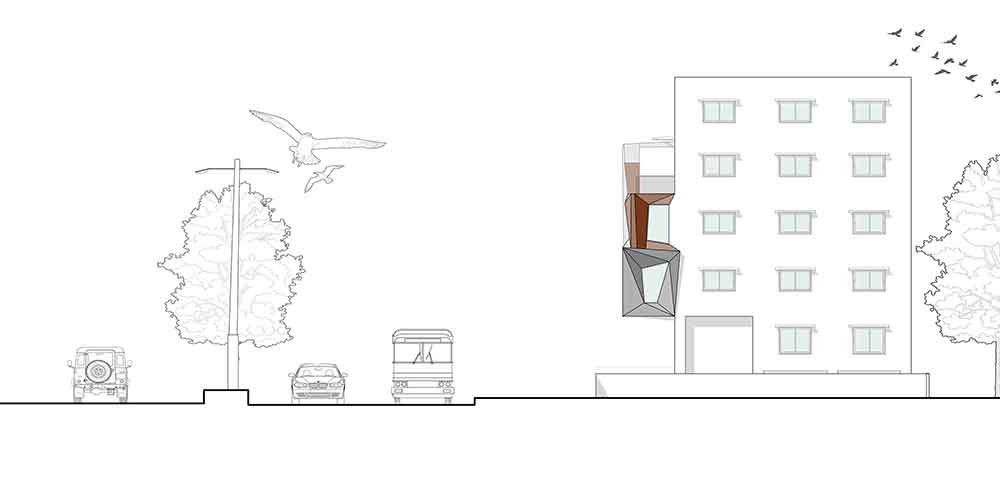
The building announces itself as a bold monochromatic form within the layered backdrop of the city. Its architectural language is shaped through a series of sculptural geometric gestures that emerge from and extend beyond the primary volume, lending the building a sense of movement and visual energy. As one moves past, the architecture reveals a constantly changing interplay of mass, depth, transparency, and shadow, creating a facade that feels animated by the movement around it. The sculpted forms transform a straightforward commercial programme into a dynamic urban presence, one that continually shifts in character through changing viewpoints, light conditions, and occupation.
The project finds its strongest expression through a family of deeply recessed apertures generated from these sculpted forms. Occupying the depth of the building envelope, they transform the facade into a layered composition of solids and voids while establishing a nuanced relationship between the interior and the city beyond. Varying in scale, proportion, and geometry, the apertures are carefully shaped to create moments of openness, compression, and visual focus.
Their depth lends the building a sense of permanence and weight, while their geometry introduces a degree of intrigue and discovery that unfolds gradually through use and occupation.
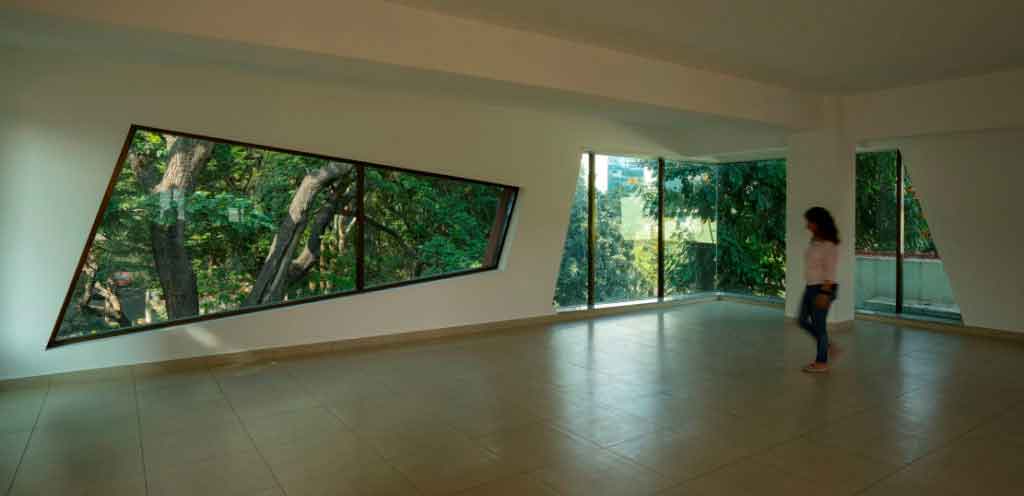
Glass is integral to this architectural language. Set deep within the sculpted openings, it becomes part of the spatial depth of the facade rather than a separate layer applied to it. Throughout the day, reflections of the surrounding rain trees, fragments of sky, and the movement of the street become woven into the architecture itself. At the same time, daylight filters deep into the interior, creating work-spaces that remain visually connected to their surroundings while retaining a sense of enclosure and comfort.
From within, the apertures become instruments through which the city is experienced. Their angled geometries frame the outside world in unexpected ways, transforming everyday views into a constantly changing sequence of visual encounters. The canopy of the rain trees drifts across these openings throughout the day, appearing as fragments of foliage, shifting shadows, and filtered light. Passing movement, changing weather, and the rhythms of urban life become part of the spatial experience, allowing the building to maintain a continuous dialogue with its context.
The project ultimately explores the relationship between visibility and occupation, between the image of a building in the city and the experience of inhabiting it. What begins as a bold sculptural presence along a busy commercial street reveals itself as a carefully crafted framework