C K C Museum | Bangalore
Built-Up Area
Scope of Work
Status
Year
Photographs
:
:
:
:
:
5500 sqft.
Interior
Completed
2022
Shamanth

Celebrating 150 years of successfully being a brand C Krishniah Chetty (CKC) Group of Jewelers at Bangalore initiated to celebrate its history by creating a museum to house and exhibit their creations. To be able to sustain and be successful for 150 years is no mean feat and our effort was to process that with immense responsibility in weaving a vision which would interestingly straddle the worlds of art, history and retail. From the beginning our focus was not just to design a space to house and exhibit collectives but to design a space which would be sensitive to the narratives CKC has been part of over the 150 years of its existence.

The space has been designed as a blend of traditional craftsmanship and eclectic aesthetics that reflects the brand’s design aesthetics. Bright colors are used to epitomize vibrancy, richness and celebration of life which is very quintessentially Indian.

CKC group of Jewelers started in 1867 by selling their merchandise to the British Cantonment in Bangalore. Reflecting back to the time of its start the design drew inspiration from the design tenets of the Georgian, Victorian era and its influences on Indian design while it was a colony of the British empire. But as one walks through the space the design effort has been to engage design ideas of all subsequent times.

The Crystal Museum Salon occupies a space of 5500 square foot on the 2nd floor above the retail stores of the brand at Bangalore and has been created as an exclusive store for the sale of heirloom jewelry with entry through invitation only. The brand has been the official jewelers to many royal families of the Deccan as well as rest of India such as the a) Mysore Royal Family b) Nizam of Hyderabad c) Travancore Royal Family d) Gondal Royal Family e) Sandur Royal Family f) The kingdom of Pudukkotai just to name a few.

The seating area of the entrance lobby is designed with inspirations from Georgian interiors with pseudo Greek column, a decorative coffered false ceiling with chandelier and decorative objects that reflect that era.

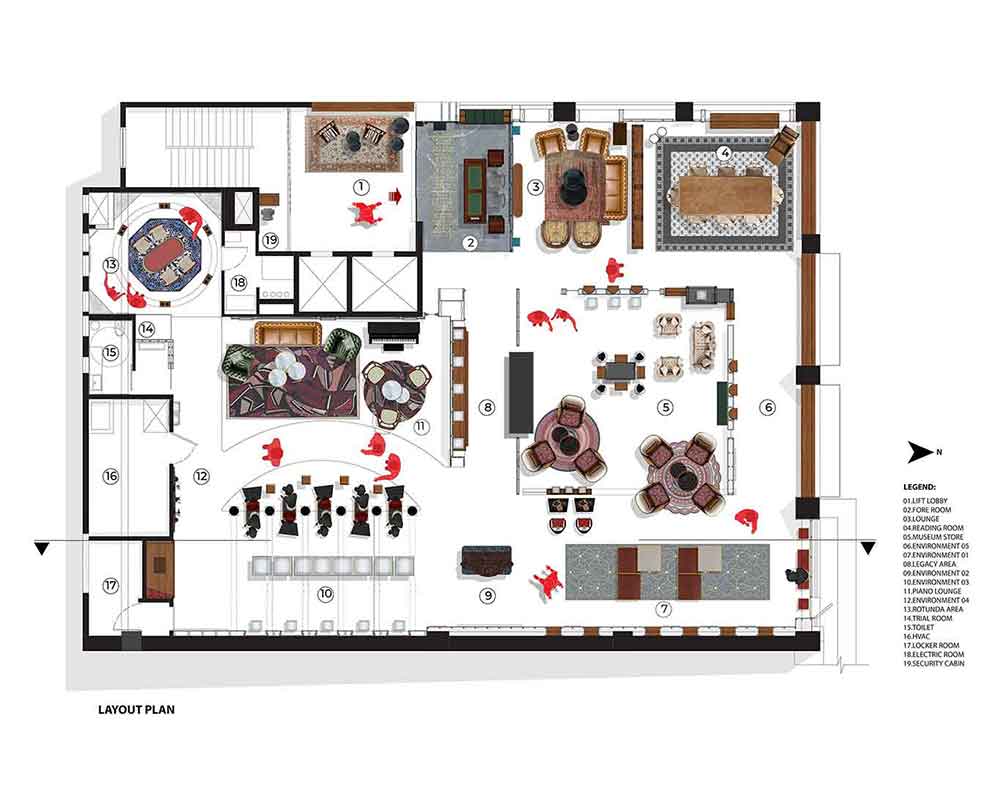
Throughout the museum salon the design palate oscillates between the old and the newer and in turn presenting an eclectic but nuanced visual presentation. The spaces of the museum are divided into the following in accordance with the programmatic division of the museum

a) A fore room area where guests are received. This space also functions as a billing counter for any merchandise bought. b) A legacy corridor which showcases the brands past associations and the works of the previous generations of CKC ownership and management. c) A visitor’s lounge where guests are familiarized with the brand CKC through audio visual presentations. The lounge has been designed with neo classical ideas to reflect to a time when the brand started. The Chester sofas, the decorative wooden false ceiling with a chandelier, the stylized drapes that hangs in the openings, the wooden detailing and the furniture are all stylized to connect one to the grandeur of the era when the brand started. d) A library with a reading table. This space is meant for research, knowledge, discussions and presentations. This space is also designed to be flexible for larger gatherings and events. e) A Museum store with comfortable seating where design and merchandize can be discussed with customers. Jewelry has intricate details and is highly customized. f) Spaces for exhibits. These spaces have been designed as a backdrop to complement the many exhibits in the space which are quite intricate in design. The exhibits range from small pieces of jewelry to large furniture which was made for the many royal families that CKC was associated with. The museum is divided into multiple spaces and the design of each has been closely calibrated to the exhibits it would house. CKC has had a long and illustrious association with many of the royal families of the south. Not only were they the official jewelers for many of them but they also made highly detailed and crafted objects ranging from doors to a palace to dining tables to beds etc. Many of these designs are brought to life in the museum through the aid of cinematic presentations on large digital screens juxtaposed with replicas of the originals to create narratives of the past and engage one in an immersive experience. Interactive screens placed around the museum also allows one delve further into the history of the brand. g) A piano lounge with a bar as a social space for entertainment. h) A discussion space with a trial room which we call as ‘The Rotunda’ since it has a circular stepped ceiling imitating the internal contours of a dome.

The Crystal Museum Salon is a complicated story to tell. Documenting 150 years of narratives and transforming them into physical containers to express them is replete with visual complications of clarity, overlaps and spatial blurs between transitions…..and all in just 5500 sqft. Throughout the museum the design palate oscillates between styles, the old, the newer and in turn presenting an eclectic but nuanced visual presentation. Multiple styles, physicality’s were researched and strategies of expressions conceived to build a seamless collage. Different expressions of craft on materials were meticulously prototyped and subsequently adopted to build the sequences for the narratives. Technology was used extensively throughout the museum to simulate environments such as the large screens which simulated theatrical environments to situate miniaturized versions of objects that were created by CKC in the past such as a door for the Palace at Mysore. Technology such as tablets and interactive screens were also used extensively to allow an experience beyond the physical space.