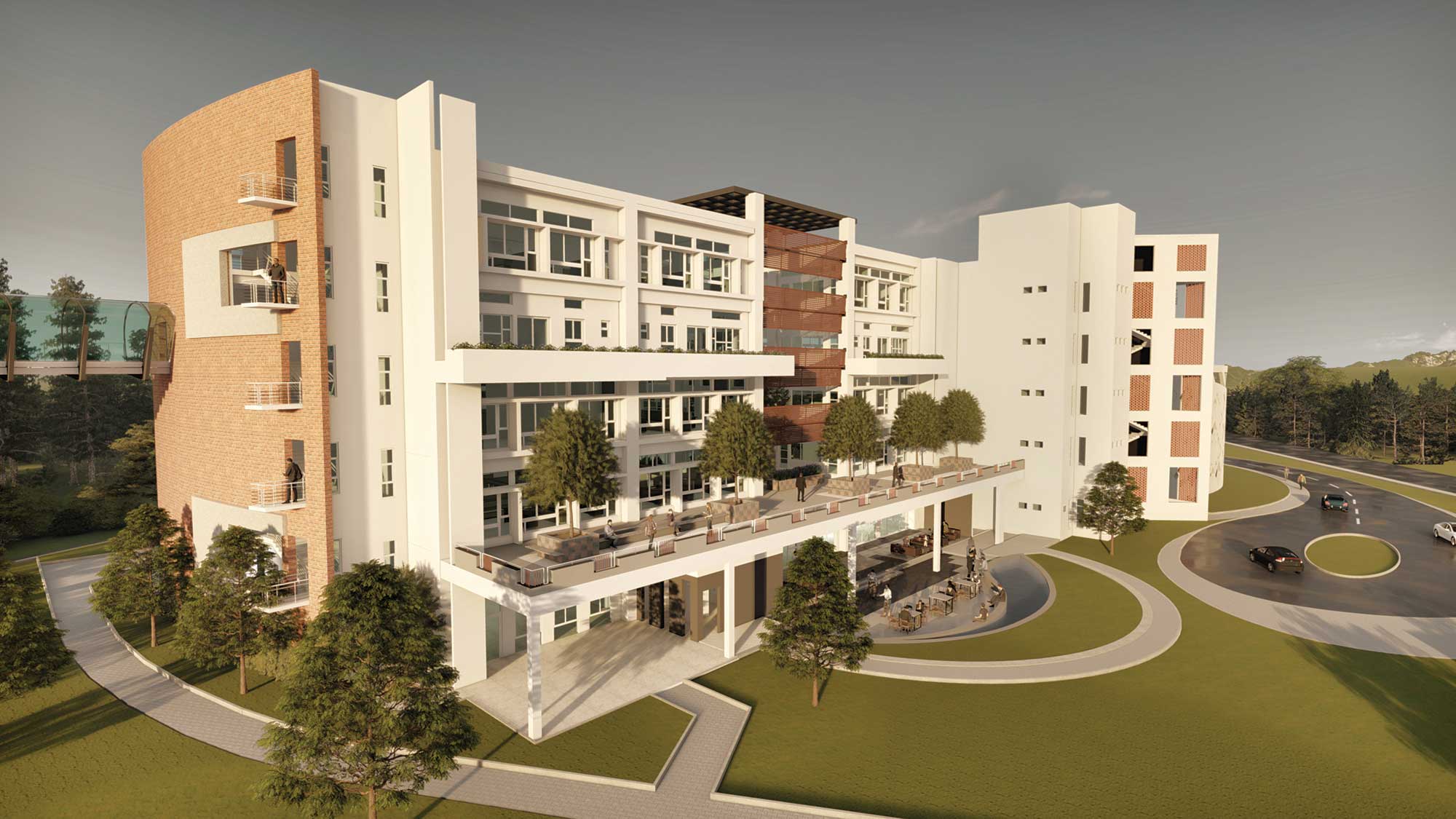
The project is an initiative of Karnataka Power Corporation Limited (KPCL) in their Raichur Campus to set a newbench mark of Sustainability in Office Building Design. This building is an Administration Building that will house the engineers responsible for the eight Coal Fired Power Plants in the Raichur Thermal Power Station Campus.
TRaichur is located in North Interior Karnataka and is characterized as a hot and dry region. It receives very little rainfall, approximately 713mm annually. Raichur is located between the two rivers Krishna and Tungabhadra river and today it boasts of a rich cultural heritage as various dynasties have ruled over Raichur.
The brief given to us, by the client was minimal. We had to design a sustainable building that can set an example to the other private and public developments in Karnataka.
It had to be simple, cost effective and had to enhance the experience of working for the occupants, in an otherwise underdeveloped town.
The 1 Lakh sqft office building is designed as a low structure (Ground +4) and occupies a small footprint in a 6 acre site. Careful planning has gone into the master plan, so as to look at it beyond pure functionality. The flow of the roadways and pathways are an attempt to artfully and skillfully traverse the land so as to preserve the existing green cover and also to frame the views to the 8 power plants that are situated in close proximity. Additional dense green cover and trees are proposed as an effort to soften the hard landscape and alter the microclimate.


DESIGN APPROACH
This project is an illustration of our approach to design where in we explore multiple cross sections and platforms ranging from historical and cultural references alongside formal expression and modernity. The design of the building evolved out of an effort to devise a highly efficient building envelope which not only performed climatically but also acted as a connector of history, culture and context. The building is peripherally contextualized by a skin with perforations inserted with stone jali, within which multiple spaces are organized and layered to bring in comfort and optimization of functionality. Key design elements that we felt were integral for the success of the project were
a. Orientation and Massing
The building footprint was planned and positioned so as to avoid cutting of existing trees. The building is predominantly a linear building that has a shift in the axis as a response to the site conditions and is oriented with its longer surfaces towards North and South. The facade has vertical fins spaced optimally, so as to reduce direct heat gain. Two courtyards have been inserted strategically so as to ensure access to daylight for all. The Southern volume is one storey higher than the northern volume. This allows the habitable terrace to be shaded. All the utility areas, or the core is grouped in the centre of the longitudinal volume where there is a shift in axis in the otherwise longitudinal building. The two wings of office area are undisturbed so as to allow entry of natural light to all interior areas.
b. Program Distribution for Sustainability
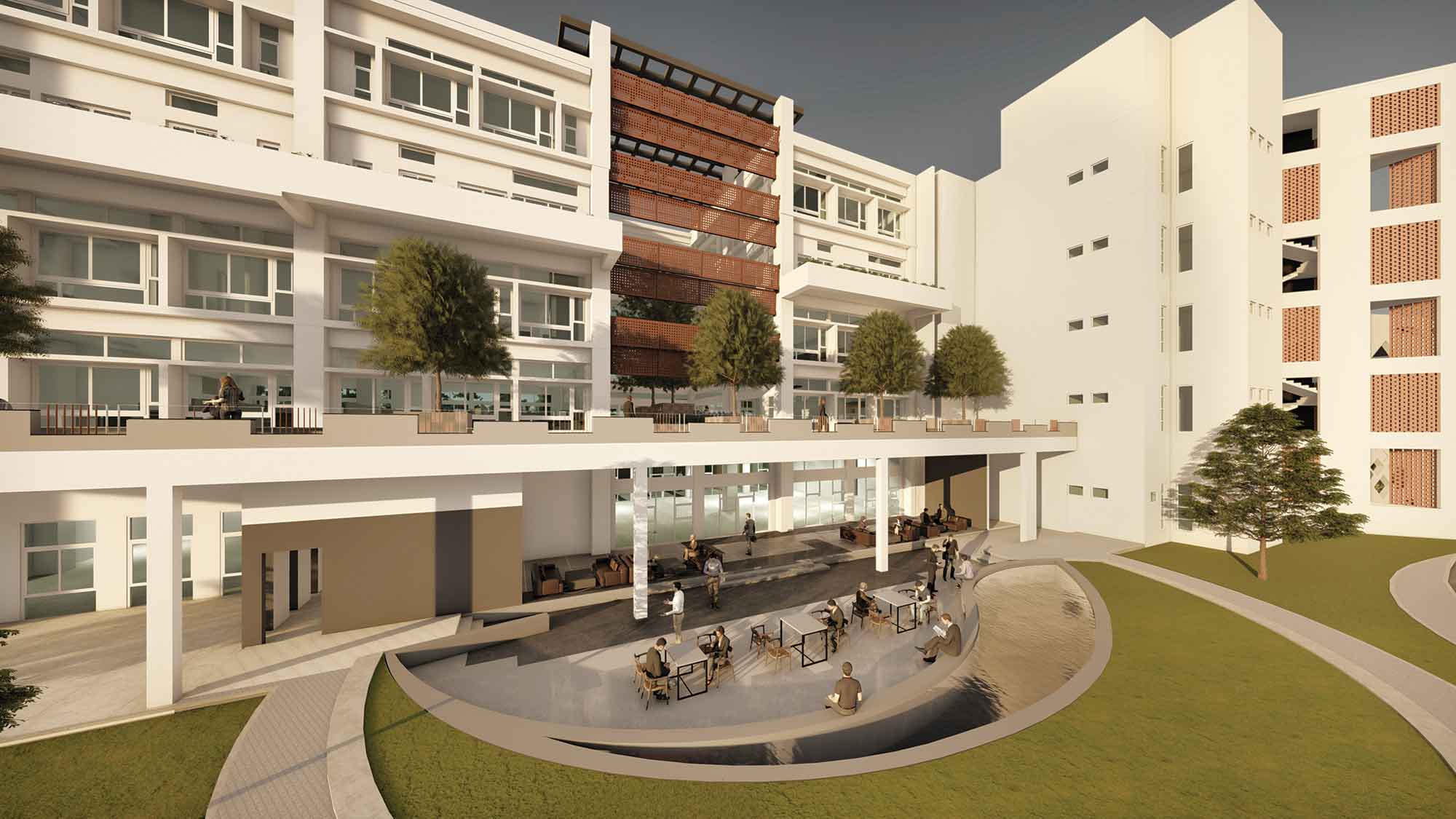
Spaces that are not used through the day or used temporally are situated in the ground floor. The reason is to prevent heat gain from the ground to the areas that are occupied on a permanent basis such as cabins and open office areas. All office spaces and cabins are located in first floor and above. All the areas in ground floor areas are naturally cooled through pre-cooled air entering from earth air tunnel. The landscape and water body together also shade the ground floor and through evaporative cooling comfort temperatures can be maintained. The cafeteria is intentionally at a lower level than the rest of the ground floor and is over 5m in height. A large water body is positioned alongside the cafeteria in the Southern Side. In addition to evaporative cooling due to the water body, the cafeteria is also supplied with pre-cooled air from Earth Air Tunnel to keep it at comfort temperatures throughout the year.
c. Visual Vistas
The fenestrations, the space planning, landscape and water bodies are designed in a manner so as to create frames/ vistas at multiple levels and multiple locations. These views link the inside to the outside by framing landscape focal areas. The intention was not to be limited by artistic rendition of a building but be sensitive to sizing and positioning of windows strategically so as to perfectly frame the landscape and bring in the outdoors to the indoors. The two bridges are also located at two levels to enable one to experience the vastness of the powerplants and the tall chimneys.
d. Design of courtyards, decks and landscape on the different levels
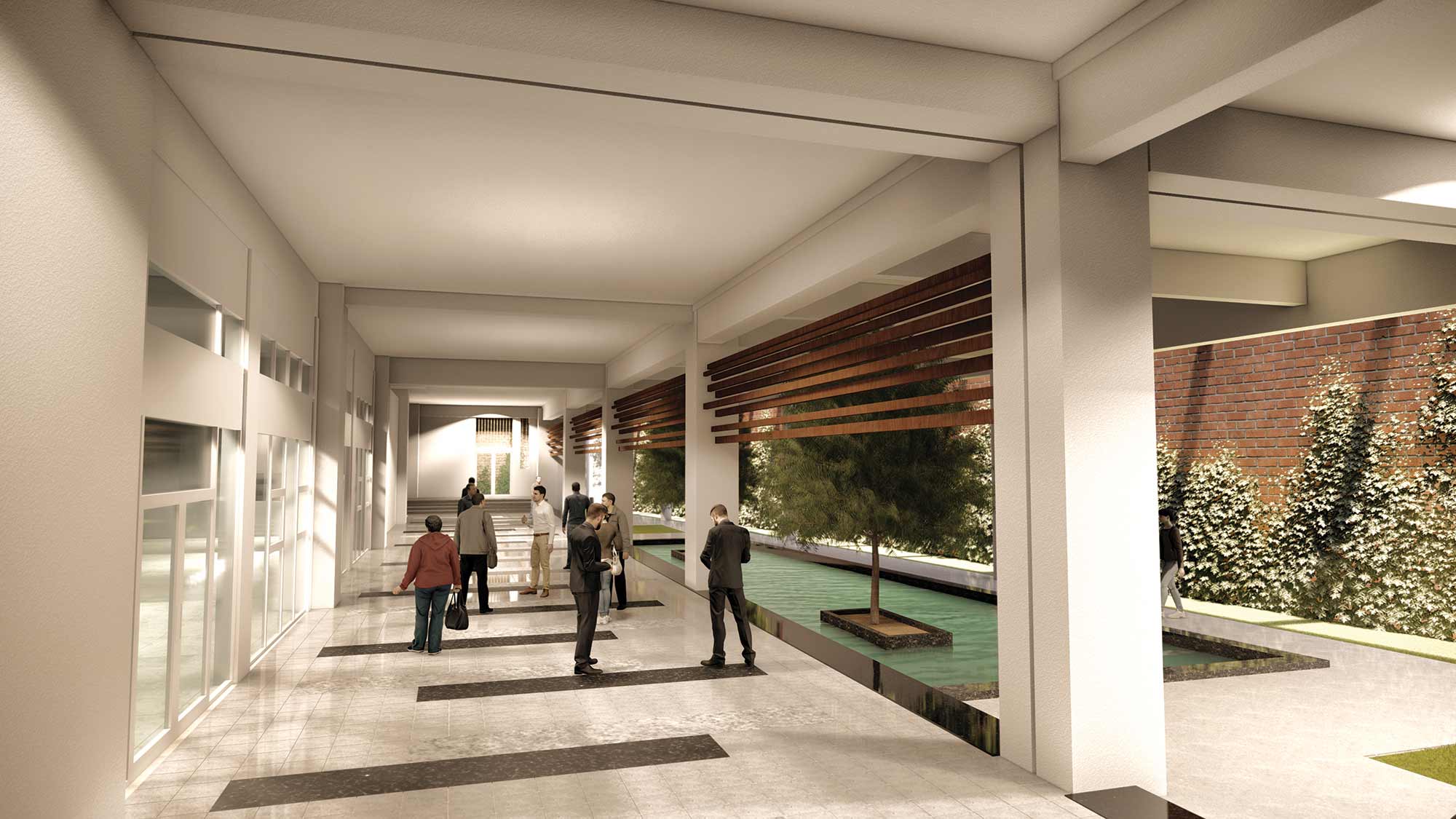
Two voids are created in the longitudinal volume for insertion of courtyards. The courtyards are covered with pergolas on the top and perforated panels on the side to cut out entry of direct sunlight into the courtyards. This is to make the courtyards habitable and to also to enable stack effect where hot air rises up and cool air enters the offices. One of the courtyard extends in to a deck designed with landscape and seating to allow for people to engage with the outdoors. At the ground level between the skin and the building in the Northern half, landscape and waterbodies dominate with seating designed and positioned to take advantage of the microclimate created as an effect of water and landscape. At the southern side where the cafeteria is situated, on one side is a long passageway with a single storey wall with slits in the wall and small openings in the roof to create a play of shadow and light. On the other side of the cafeteria is a water body that is again surrounded with landscape to bring down the microclimate.
There is a roof garden on the Northern terrace which is shaded by the Southern terrace which is a level higher and thus making it more habitable.
(The northern side is a G+3 structure and the southern side is a G+4 structure)The roof garden is primarily a grid of trees that can give shade, which not only allows one to use the space but also prevents direct heat gain from roof.
e. Fins
The design approach for this building is to design so as to reduce heat gain from ground, from the roof and from the sides. While the Northern Volume facades are shaded by the skin and pergolas, the Southern volume façade is characterized by vertical fins to allow only for indirect light. The spacing of the fins is based on energy modeling and daylight simulation to ensure adequate daylight but minimize heat gain.
f. Skin
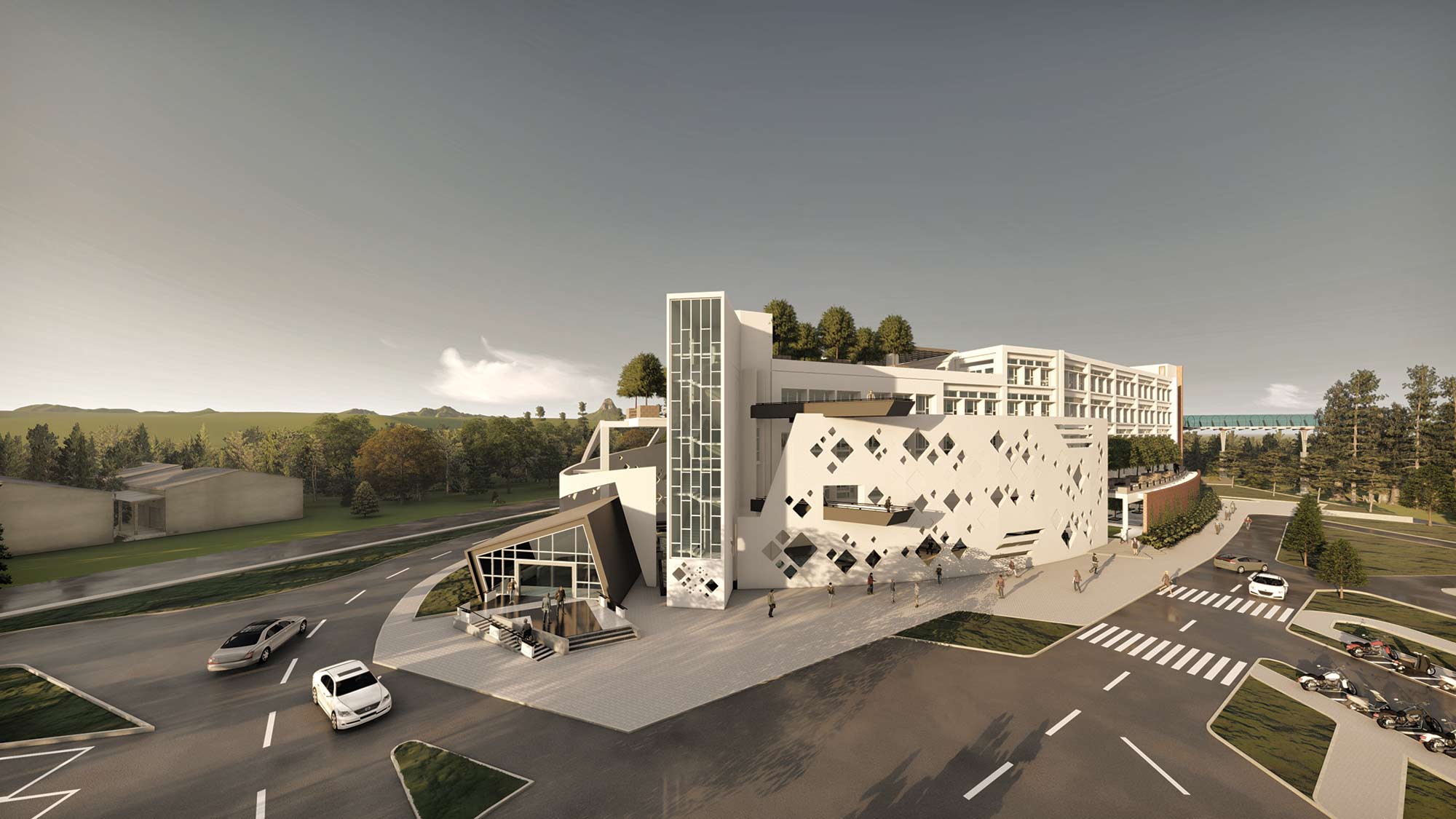
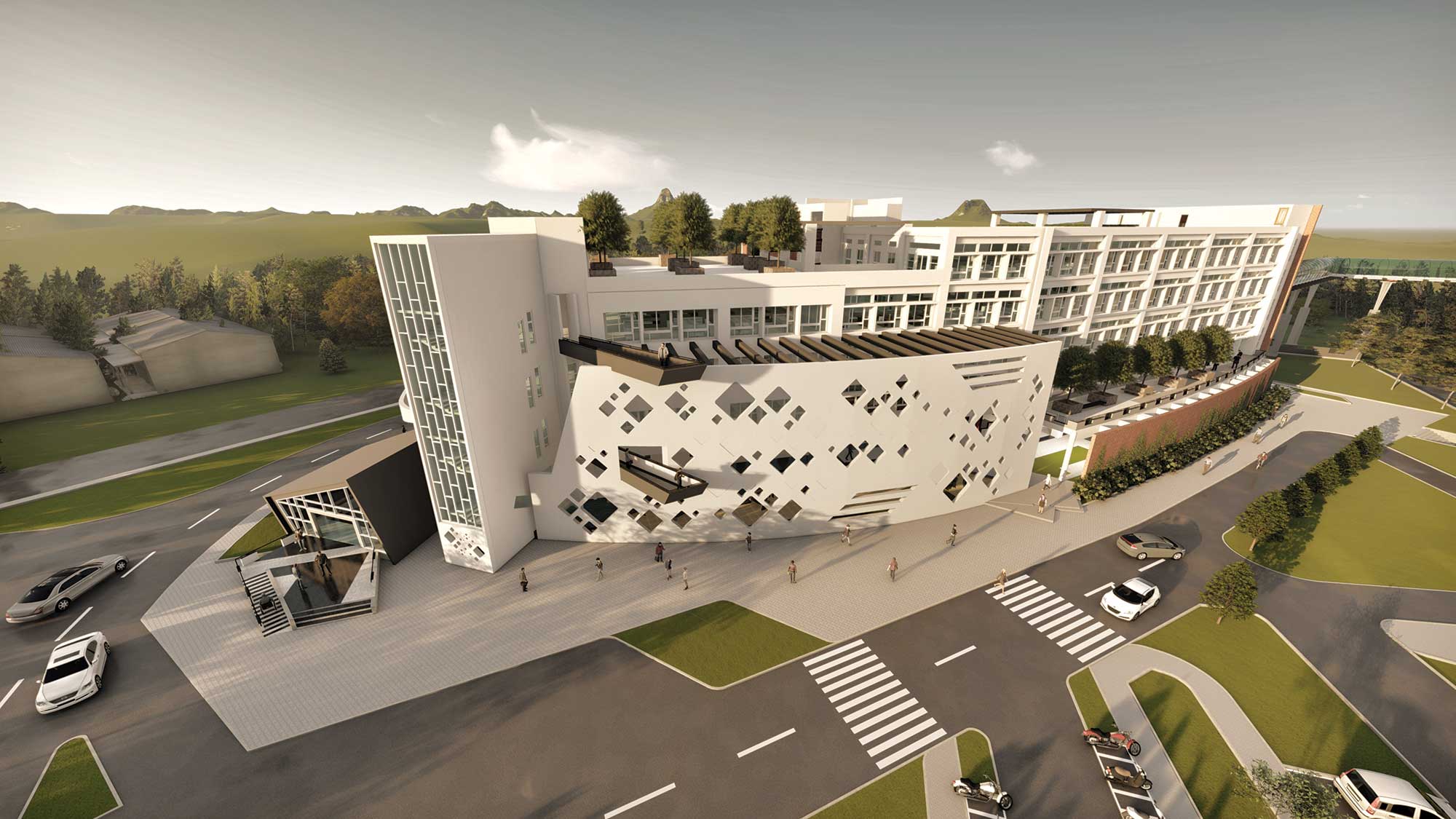
A perforated wall or what we are calling the skin of the building, surrounds the building envelope a little distance away from the shell. The multiple perforations in the skin are envisioned to be filled with stone jali from local artisans so as to reflect the traditional craftsmanship of Raichur and also to create a sense of belonging to the town. This enabled us to create a building façade embedded in tradition. The play of light and shadow is seen in the spaces between the building and the skin. The perforations of the skin in addition to being a surface for art is also designed to filter light into the building tastefully.
g. Water
The space in between the building and the skin is shaded with pergolas and designed with landscape and waterbodies to create a zen like ambience. This space has been envisioned to be a space that can bring on chance interactions, serve as a community outdoor space and serve as a sanctuary in an otherwise harsh climate which forces one to be indoor. This inbetween space lends to the character and language where there is a seamless flow of spaces between the built and the unbuilt.
h. Horizontal and Vertical Entry points
The main entrance is a stand alone inclined volume and is separated from the office building and a bridge over a waterbody connects the two. The entrance volume was envisioned as a space where in addition to being a lobby can also serve as an area where works of KPCL can be displayed. The inclined exposed concerete volume and glazing on two opposite sides from floor to ceiling which overlooks the waterbody is meant to evoke a balance of energy and serene environment. It is also a intended to evoke a sense of intrigue of what is beyond this volume.
i. Materiality
The building is intended to be raw with stone jail and cement finish walls. The concrete columns and beams are left unplastered so as to act as heat sink during the day. The ceilings are also left unplastered. This enables us to not only use less material but also to be in line with the raw feel for the space. The masonry blocks, made from flyash is the primary building material. Flyash is a by product of electricity generation from coal plants and is thus enabling KPCL to reuse its waste. The flooring specifications primarily include natural stone such as shahbad and tandor for all outdoor areas and passages abutting landscape. Exclusive materials or materials that need to be imported from across the country or continent are avoided.
j. Bridges
There are two viewing Bridges and one bridge that connects the building to the control centre of the power plant. The two viewing bridges that are accessible to both the occupants and the public, are designed so as to give the person a complete view of the all the power plants. The two bridges are situated at two levels, are projected from building outward, puncture through the skin and are cantilevered beyond.
k. Renewable Energy
Raichur is blessed with either hot or very hot climate. Thus 7.5% of renewable energy has been planned through Solar Energy. In addition cogeneration from Kitchen has also been incorporated into the design. Waste heat from cooking process via heat recovery is proposed to be used to meet the hotwater demand of the cafeteria.



KEY SUSTIANABLE DESIGN CONCEPTS
This project is an illustration of our approach to design where in we explore multiple cross sections and platforms ranging from historical and cultural references alongside formal expression and modernity. The design of the building evolved out of an effort to devise a highly efficient building envelope which not only performed climatically but also acted as a connector of history, culture and context. The building is peripherally contextualized by a skin with perforations inserted with stone jali, within which multiple spaces are organized and layered to bring in comfort and optimization of functionality. Key design elements that we felt were integral for the success of the project were
a. Layering:
We have adopted a system of layering of building envelope that most importantly serves to reducing heat gain into the main building, as the direct incorporation of thick walls to insulate the building is not feasible in modern day buildings.
The inner most or the first layer is the core, which is the concrete beams and slabs with vertical concrete fins. The water bodies located around the core of the building structure, forms the second layer and enables evaporative cooling. The third layer is the Landscape on all roof slabs and around the building envelope.
The skin with multiple perforations wraps around the building so as to shade the building from direct heat gain. It also shades the water body and allows only entry of diffused light. Through the unique system of layering, a design language has evolved and the intention of creating comfortable environments within the office area through this approach was rationalized.
b. Earth Air tunnel:
Natural heating or cooling of a building through use of Earth air tunnel was a commonplace feature in traditional buildings. We have proposed an Earth Tunnel to pre-cool the air prior to entering the Air Handling Unit where it is further cooled to the required temperature if required.
As we know the air temperature below the ground remains constant throughout the year. Earth Air Tunnel with the entry of the air at a certain distance away from the building traverses through the long tunnel 4m below ground and through heat exchange is pre-cooled prior to entering the AHU.
c. Night Cooling:
For this project, we have incorporated a feature called as Night Cooling. By studying the climatic condition of Raichur, we observed that there is a dip in night temperature for 4 months in a year. Night cooling takes advantage of the high thermal mass of concrete, which acts as a heat sink during the day and cools during the night when cool air from outside is allowed to enter the building for 3-4 hours in a day.
CONCLUSION
To conclude, this building is an amalgamation of varying design ideologies to create a building. To summarise
- The design process though engages contemporary ideologies is deeply rooted to the place is situated in. This is a building that cannot be replicated in another city or town. Every shift, material etc has a purpose and one can term it regional modernism.
- The importance of habitable outdoor spaces can only be realized in these harsh climates where one is forced to be indoors. Artistically creating frames and vistas and lowering microclimate in select areas was vital for the success of the project.
- Integration of traditional cooling methods such as evaporative cooling, night cooling and earth air tunnel in a very modern setting so as to set an example as a Power Generation Company for all other private and public buildings around the country was essential.
- The minimal interiors and finishes are intentional so as to give an industrial and raw look which is then complemented and softened with the landscape and the vistas.
To summarise this building is a perfect example where the design process is through the amalgamation of several traditional building technology aside contemporary building techniques, art and design which together form the root, through which the building form is evolved.